
 USA Domestic
 Injectables
 Stacks
 Orals
Orals HGH
HGH Ampoules
 Peptides
 Pharmagrade
 Health & Wellness
 Other
OtherPeptides
Peptide Dosage Guide for Beginners
Feb
Peptides are becoming increasingly popular in the health, fitness, anti-aging, and research communities. However, one of the most confusing aspects for beginners is understanding proper dosage, safe handling, and accurate mixing techniques. If you’re new to peptides, you’ve probably searched for terms like peptide reconstitution guide, how to mix peptides, or peptide dosage chart—and found information that feels overly complicated or unclear.
This comprehensive guide simplifies everything. You’ll learn what peptides are, how reconstitution works, how to calculate doses correctly, and how to use a peptide dosage chart without making dangerous mistakes. By the end, you’ll feel confident handling peptides safely and accurately.
What Are Peptides and Why Dosage Matters
Peptides are short chains of amino acids that act as signalling molecules in the body. They can influence hormone release, muscle growth, fat metabolism, skin repair, recovery, and many other biological functions. Because peptides are biologically active, precision in dosing is critical.
Unlike many supplements, peptides are typically supplied in lyophilized (freeze-dried) powder form. They must be reconstituted with sterile water before use. This means dosage depends not only on the peptide amount in the vial but also on how much liquid you add during mixing.
Incorrect dosing can lead to:
Reduced effectiveness
Increased side effects
Wasted product
Potential health risks
That’s why a clear understanding of how to mix peptides and calculate accurate dosages is essential.
Peptides are becoming increasingly popular in the health, fitness, and research communities. At Pharmaqo Labs Store, our main store offers a wide range of research compounds, peptides, and supplements designed for quality and reliability. Whether you are just starting or an experienced researcher, you’ll find everything you need in one place.
Understanding Peptide Reconstitution
Before diving into calculations, let’s define what reconstitution means.
Reconstitution is the process of adding a sterile liquid to a powdered peptide to make it injectable or measurable. Most peptides are mixed with bacteriostatic water, which contains a small amount of benzyl alcohol to prevent bacterial growth.
When you search for a peptide reconstitution guide, what you’re really looking for is:
How much water to add
How to add it safely
How to calculate the resulting concentration
The amount of water you add determines how concentrated your solution becomes. This directly impacts how much liquid you need to inject per dose.
Essential Supplies for Mixing Peptides
Before learning how to mix peptides, gather the proper materials:
Lyophilized peptide vial
Bacteriostatic water
Alcohol swabs
Sterile syringe (for mixing)
Insulin syringe (for dosing)
Sharps disposal container
Maintaining sterility is crucial. Always wash your hands and clean vial tops with alcohol before inserting any needle.
Step-by-Step Guide on How to Mix Peptides
Let’s walk through a safe and beginner-friendly peptide reconstitution process.
Step 1: Clean Everything
Wipe the tops of both the peptide vial and bacteriostatic water vial with alcohol swabs.
Step 2: Draw Bacteriostatic Water
Using a sterile syringe, draw your desired amount of bacteriostatic water.
Step 3: Inject Slowly
Insert the needle into the peptide vial and inject the water slowly against the inside wall of the vial. Do not inject forcefully into the powder.
Step 4: Let It Dissolve
Do not shake the vial. Gently swirl it if needed. Shaking can damage delicate peptide chains.
Step 5: Refrigerate
Store the reconstituted peptide in the refrigerator unless otherwise specified.
Now your peptide is ready for accurate dosing.
How Peptide Concentration Works
This is where many beginners get confused.
The concentration depends on:
Total peptide amount (mg) ÷ total water added (mL)
Example:
If you have a 5mg vial and add 2mL of water:
5mg ÷ 2mL = 2.5mg per mL
That means each 1mL contains 2.5mg of peptide.
If using a 100-unit insulin syringe:
1mL = 100 units
0.5mL = 50 units
0.1mL = 10 units
Understanding this math is the foundation of any reliable peptide dosage chart.
Peptide Dosage Chart Explained
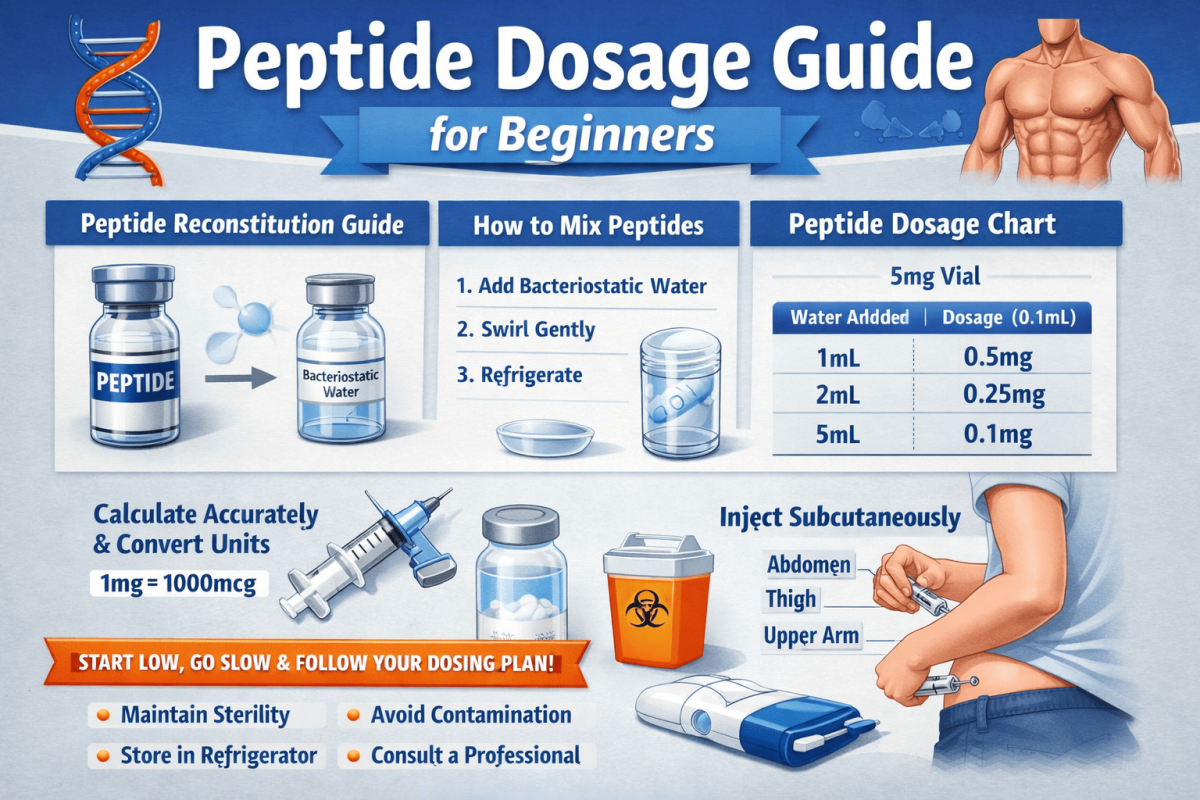
Here’s a simplified peptide dosage chart example for a 5mg vial:
| Water Added | Concentration | 0.1mL (10 units) | 0.2mL (20 units) |
|---|---|---|---|
| 1mL | 5mg/mL | 0.5mg | 1mg |
| 2mL | 2.5mg/mL | 0.25mg | 0.5mg |
| 5mL | 1mg/mL | 0.1mg | 0.2mg |
This chart shows how changing water volume changes dosage per unit.
Many beginners prefer adding 2mL or 5mL because it makes calculating smaller doses easier and reduces risk of miscalculation.
Choosing the Right Reconstitution Ratio
There is no single “correct” amount of water to add. It depends on:
Your prescribed dose
Desired injection volume
Ease of measurement
If your typical dose is small (for example 250mcg), adding more water allows for more accurate measurement.
That’s why a personalized peptide reconstitution guide is important. It should match your required dosage, not just general instructions.
Understanding Milligrams and Micrograms
Many peptide doses are measured in micrograms (mcg), not milligrams (mg).
Important conversion:
1mg = 1000mcg
So if your peptide concentration is 2.5mg per mL:
2.5mg = 2500mcg per mL
If your dose is 250mcg:
250 ÷ 2500 = 0.1mL (10 units on insulin syringe)
This conversion step is critical in every peptide dosage chart calculation.
Common Dosage Mistakes Beginners Make
Understanding how to mix peptides isn’t enough—you must avoid these common errors:
Adding too little water, making dosing difficult
Forgetting mg-to-mcg conversion
Shaking the vial aggressively
Not refrigerating after mixing
Guessing instead of calculating
Precision is everything with peptides. Even small miscalculations can double or halve your intended dose.
How to Store Reconstituted Peptides
After following a proper peptide reconstitution guide, storage becomes important.
General guidelines:
Refrigerate at 2–8°C
Avoid freezing unless instructed
Protect from light
Use within 2–8 weeks depending on peptide
Always check product-specific storage instructions.
Injection Basics for Beginners
Most peptides are administered subcutaneously (under the skin). Common injection sites include:
Abdomen
Thigh
Upper arm
Rotate injection sites to prevent irritation.
When drawing your dose:
Clean vial top
Insert insulin syringe
Draw exact units
Remove air bubbles
Inject at 45–90° angle
Dispose of needles properly.
Adjusting Dosage Safely
Never increase dosage without professional guidance. If adjusting:
Increase gradually
Monitor side effects
Track response
Follow medical advice
A well-structured peptide dosage chart helps maintain consistency and prevents accidental overdosing.
Why Accuracy Is More Important Than Volume
Some beginners focus too much on how much liquid they’re injecting rather than how much peptide they’re administering.
Remember:
The amount of peptide (mg/mcg) matters more than the amount of liquid (mL).
The water is simply a carrier. Always calculate based on total peptide content, not injection size alone.
Frequently Asked Questions About Peptide Mixing
How much bacteriostatic water should I add?
It depends on your desired concentration. Many beginners use 2mL for easier math.
Can I shake peptides after mixing?
No. Gently swirl instead.
What happens if I miscalculate?
You may underdose or overdose. Always double-check your math.
How long do peptides last after reconstitution?
Typically 2–8 weeks refrigerated, depending on the compound.
Do all peptides follow the same mixing rules?
The basic principles are similar, but always follow product-specific guidance.
Safety Considerations for Beginners
Peptides are biologically active compounds. Improper use can lead to:
Hormonal imbalance
Water retention
Blood sugar changes
Headaches
Fatigue
Always consult a qualified healthcare professional before starting any peptide protocol.
For more research-grade peptides, tools, and dosing resources, visit our Pharmaqo Labs Store homepage or explore our complete USA Peptides collection. Start your peptide journey with confidence, quality, and precision.
Final Thoughts on Peptide Dosage for Beginners
Understanding peptides doesn’t have to be overwhelming. Once you grasp the basics of reconstitution, concentration, and dosage calculation, everything becomes much clearer. The key principles are simple: maintain sterility, calculate carefully, convert units properly, and follow a structured peptide reconstitution guide.
Learning how to mix peptides accurately ensures you get consistent, predictable results while minimizing risks. A reliable peptide dosage chart removes confusion and allows you to dose with confidence rather than guesswork.
When it comes to peptides, precision equals safety. Take your time, double-check your math, and approach dosing with care. With the right knowledge and attention to detail, even beginners can handle peptides responsibly and effectively.
